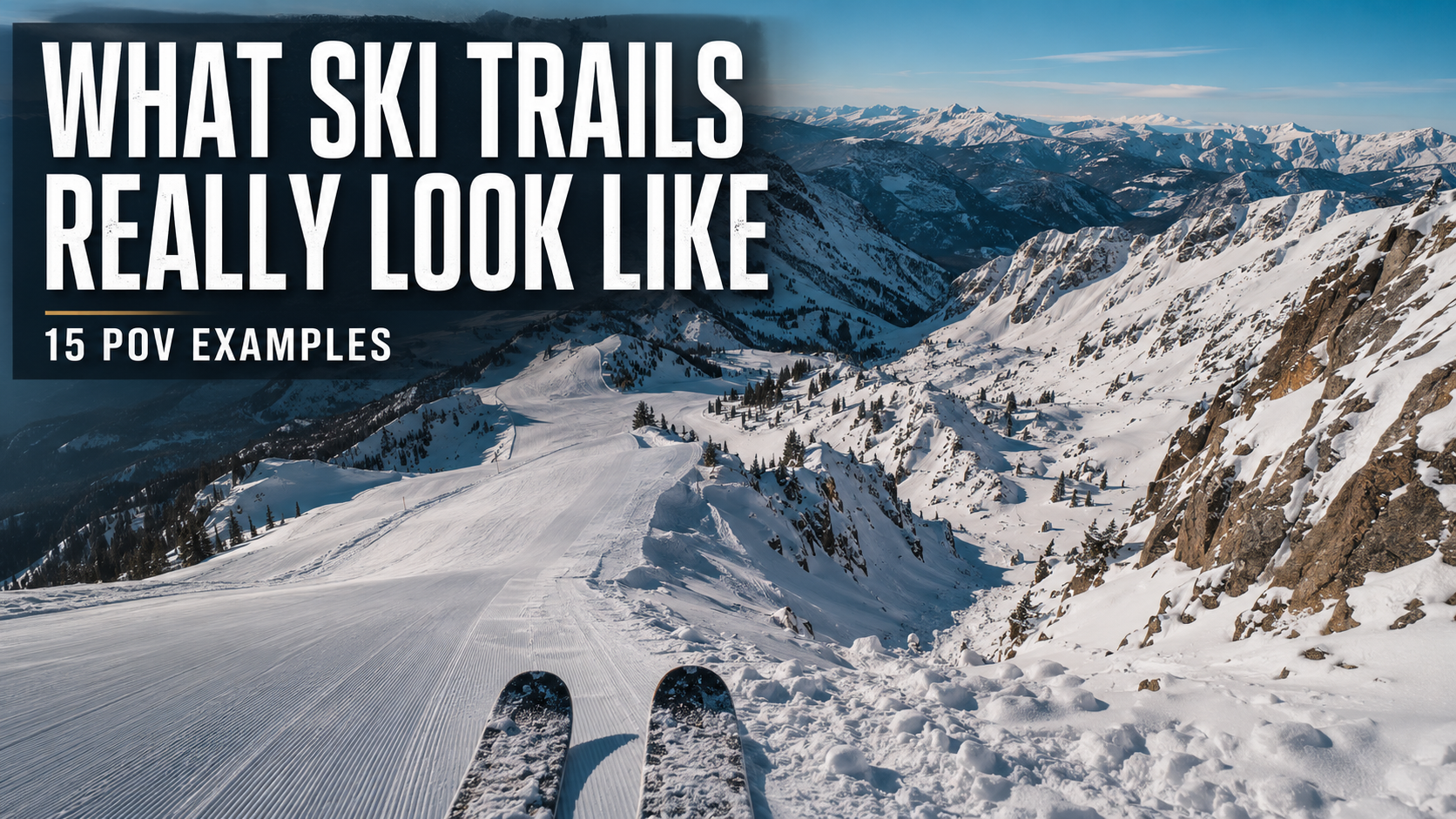
What ski-trail difficulty looks like from a skier's perspective
A green, blue, black or double-black symbol gives you a starting point, but it does not show you what a trail will feel like. Two trails with the same rating can differ in width, sustained grade, grooming, visibility, exposure, traffic and the consequences of making a mistake.
I recorded the 15 POV videos in this guide while skiing at resorts in Europe, Canada and the United States. They are not demonstrations performed under controlled conditions. They show the snow, light and trail surfaces I encountered on specific days, which is exactly why they are useful: the footage reveals differences that a trail map cannot communicate.
The videos should not be used as current snow reports or guarantees that a trail will look the same during your trip. Resort operations, grooming, weather and coverage change. Use the examples to understand the character of different terrain, then follow current signs, closures and patrol guidance when you ski.
This guide answers three practical questions:
- What do beginner, intermediate and expert ski trails actually look like?
- Why can two trails with the same rating feel completely different?
- Which terrain features should you notice before choosing a harder trail?
The direct answer
Beginner trails generally provide a manageable grade and enough room to link controlled turns. However, a beginner trail can still be long, busy, tiring or affected by poor visibility.
Intermediate trails usually add a steeper or more sustained grade. They may also become narrower, carry faster skier traffic or include sections where stopping requires greater control.
Advanced and expert trails can combine sustained steepness, exposure, narrow sections, ungroomed surfaces and natural obstacles. The margin for recovering from a mistake is often much smaller.
These descriptions are general. Ratings are relative to the ski area and classification system. Conditions can move the practical difficulty in either direction: fresh groomed snow can make a trail more manageable, while ice, fog, wind or poor coverage can make familiar terrain substantially harder.
Ski-trail difficulty at a glance
| Trail level | What you may see | What the rating does not tell you | Examples in this guide |
|---|---|---|---|
| Beginner | Manageable grade, clear direction and space for controlled turns | Length, traffic, visibility, fatigue and difficult lift connections | Banff Avenue; Green Monster |
| Intermediate | Steeper or more sustained grade, higher speeds and greater variation | Whether the trail narrows, becomes firm or includes a difficult isolated section | Timber Ridge; Andy's Encore; Easy Does It; Bow Lane |
| Advanced and expert | Sustained steepness, exposure, narrow sections, natural features or ungroomed snow | Surface quality, visibility, consequences of a fall and whether escape options exist | Youla 21; Pierre à Ric; Rattler; Triple Zero; Rendezvous Bowl; Perseverance; Wildflower Downhill; Olympic Course |
| Linked circuit | Multiple trails and lifts forming a continuous journey | Total time, navigation, changing weather and the need to reach lifts before closing | Sellaronda |
What beginner ski trails look like
A beginner trail should allow a developing skier to control speed and link turns without facing sustained steep terrain. That does not mean every green trail is suitable for a first day. A long descent can become exhausting, and even a manageable grade may feel difficult when visibility is poor or the snow is firm.
The most useful visual clues are trail width, the consistency of the grade, the direction of traffic and whether the trail contains long stretches without a comfortable place to rest. Beginners should also consider how they will return to the learning area or base. A green trail reached through a difficult connection may not be a practical choice.
Banff Sunshine — Banff Avenue Beginner
What the video shows: A long beginner trail through the Canadian Rockies, with the generally manageable grade and substantial distance recorded during our visit.
What to notice: Banff Avenue allows beginners to experience a long mountain descent rather than remain in a small learning area. The distance also means skiers need enough stamina and confidence to complete it.
Our visit — February 2024: Fog followed a rapid temperature increase from approximately −35°F to 10°F, reducing visibility and changing how the trail felt.
Watch on YouTubeDeer Valley — Green Monster Beginner
What the video shows: A beginner trail with a manageable grade and the groomed surface we encountered during our visit.
What to notice: The trail provides space to maintain a controlled pace. Compare its grade and skiing speed with the longer intermediate and expert examples later in this guide.
Our visit — March 2025: Deer Valley had early-spring conditions, with remaining powder in some areas and softer snow developing on sun-exposed terrain.
Watch on YouTubeWhat these beginner videos do not prove
A calm video does not guarantee an easy experience. The camera may reduce the visual impression of steepness, while a wide-angle lens can make a trail appear broader or flatter. The person recording also already knew how to control speed and direction.
If you are still learning to stop, turn or load a lift reliably, begin in the resort's designated learning area and consider a lesson. Moving from a learning area to a long green trail is a meaningful step, not an automatic progression based only on color.
What intermediate ski trails look like
Intermediate terrain is where trail ratings begin to conceal large differences. One blue trail may be wide, groomed and consistent; another may narrow, become firm or contain a steeper section that determines the difficulty of the entire descent.
An intermediate skier should watch for sustained grade rather than judging only the steepest moment. A trail that remains moderately steep for several minutes can require more control and endurance than a short steeper pitch followed by an easy runout.
Copper Mountain — Timber Ridge Intermediate
What the video shows: A wide intermediate groomed trail with a consistent grade and views toward Copper Bowl.
What to notice: The available width provides room to control turn shape. This is a useful example of intermediate terrain that supports a steady skiing rhythm.
Our visit — January 2022: We recorded the Copper Mountain trails during clear weather, deep powder conditions and temperatures near −30°F.
Watch on YouTubeCopper Mountain — Andy's Encore Intermediate
What the video shows: A long Front Side groomed descent with a relatively consistent grade and room for controlled turns.
What to notice: The sustained descent requires continued speed control even though the trail remains broad. Compare it with Timber Ridge before moving to Copper's expert examples.
Our visit — January 2022: Clear weather made the terrain easy to read, while the very low temperature required careful preparation for exposed lifts and repeated runs.
Watch on YouTubeJackson Hole — Easy Does It Intermediate
What the video shows: More manageable terrain for developing skills, providing a useful contrast with Jackson Hole's expert summit trails.
What to notice: Trail width and a less exposed setting make the descent easier to interpret than Rendezvous Bowl. The recorded surface was still affected by a long period without fresh snow.
Our visit — January 2025: Temperatures were near −15°F, and approximately 20 days without significant snowfall had left many exposed surfaces firm or icy.
Watch on YouTubeSun Valley — Bow Lane Intermediate
What the video shows: A groomed intermediate trail with a long, relatively even grade on Bald Mountain.
What to notice: The consistent grade supports controlled turns, but the uninterrupted fall line can allow speed to build. Intermediate skiers should maintain deliberate turn shape throughout the descent.
Our visit — February 2025: We recorded the Sun Valley trails during clear weather with temperatures near 12°F. Snow conditions were beginning to resemble early spring despite the cold mornings.
Watch on YouTubeWhat advanced and expert ski trails look like
Advanced and expert terrain is not defined by steepness alone. A wide, steep trail with a smooth surface may be easier to manage than a narrower trail with ice, bumps, rocks or changing visibility. Exposure also matters: a skier may have fewer safe places to stop, traverse or reconsider the descent.
The following videos range from groomed expert trails to open bowls and technical terrain. They should not be interpreted as a progression checklist. Being comfortable on one black trail does not establish readiness for every black or double-black trail at another resort.
Courmayeur — Youla 21 IntermediateExpert
What the video shows: An upper-mountain descent through open terrain, with extended views toward the Mont Blanc range.
What to notice: The exposure, sustained descent and changing snow at lower elevations matter as much as any isolated pitch.
Our visit — March 2023: Snow fell regularly above 2,000 meters, while lower elevations had softer and slushier spring surfaces.
Watch on YouTubeChamonix — Pierre à Ric IntermediateExpert
What the video shows: A long descent from the Grands Montets sector toward Argentière, including the transition from higher terrain to the valley.
What to notice: Snow coverage, surface quality and trail width change with elevation. A top-to-bottom trail can become more difficult when lower snow coverage deteriorates.
Our visit — March 2023: Snow fell regularly above 2,000 meters, but little accumulated in the valley and most top-to-bottom trails were closed.
Watch on YouTubeCopper Mountain — Rattler Expert
What the video shows: A steeper expert trail with tighter sections where controlled speed and reliable edge control are important.
What to notice: Rattler offers less space for wide turns than Copper's intermediate groomed trails. The tighter terrain reduces the margin for correcting excessive speed.
Our visit — January 2022: Deep snow and clear visibility provided favorable conditions, but temperatures near −30°F increased the consequences of stopping for an extended period.
Watch on YouTubeCopper Mountain — Triple Zero Experts Only
What the video shows: Sustained steep terrain with natural features and limited room for error.
What to notice: The difficulty comes from the combination of steepness, terrain features and the need to make controlled decisions continuously. This is not simply a faster version of an intermediate groomed trail.
Our visit — January 2022: Powder conditions improved the surface compared with an icy day, but the terrain still required expert-level control.
Watch on YouTubeJackson Hole — Rendezvous Bowl Expert
What the video shows: Steep and exposed open-bowl terrain near the summit, with changing visibility and broad Teton views.
What to notice: The open terrain provides few visual reference points when visibility deteriorates. Firm snow can make speed control and a fall substantially more consequential.
Our visit — January 2025: Temperatures were near −15°F, and approximately 20 days without significant snowfall had left many exposed surfaces firm or icy.
Watch on YouTubeDeer Valley — Perseverance via Stein's Way IntermediateExpert
What the video shows: A longer sequence of groomed intermediate and advanced pitches requiring sustained speed control.
What to notice: Grooming does not eliminate difficulty. A long, steep groomed descent can demand greater endurance and edge control than a shorter ungroomed section.
Our visit — March 2025: Early-spring conditions produced remaining powder in some locations and softer snow on sun-exposed terrain.
Watch on YouTubeSnowbasin — Wildflower Downhill Expert
What the video shows: A sustained Olympic downhill trail with open pitches, steeper sections and broad Utah mountain views.
What to notice: Wildflower Downhill provides an opportunity to experience the scale and sustained pitch of Snowbasin's Olympic terrain. Its racing history does not reduce the need to maintain control.
Our visit — March 2025: Early-spring conditions left powder in protected areas while softer snow developed elsewhere during the day.
Watch on YouTubeSun Valley — Olympic Course Expert
What the video shows: A steep and sustained expert descent where deliberate speed control and precise turns are necessary.
What to notice: Compare the sustained grade with Bow Lane. Both are on Bald Mountain, but Olympic Course provides much less opportunity to relax or allow speed to build unintentionally.
Our visit — February 2025: Clear weather made the fall line easy to see, while the snow was beginning to resemble early-spring conditions.
Watch on YouTubeWhy the Sellaronda belongs in a separate category
The Sellaronda is a circuit around the Sella massif, not one ski trail. Completing it requires a sequence of lifts and groomed trails through four valleys. The challenge comes from the total journey: navigation, changing conditions, sustained movement and reaching each connection before lifts close.
A skier may be comfortable on the individual descents but still be unprepared for the complete circuit. Weather, lift queues and an early wrong turn can affect the day. The video is useful because it shows how the experience unfolds across multiple ski areas rather than presenting only one descent.
Dolomiti Superski — Sellaronda IntermediateAdvanced planning
What the video shows: A lift-linked journey around the Sella massif, including groomed descents, valley transitions and close views of the Dolomites.
What to notice: Watch how often the circuit relies on lift connections and how the terrain changes between valleys. Completing it requires steady progress, suitable weather and attention to operating hours.
Our visit — March 2024: We completed the circuit during a 10-day Val Gardena trip, immediately after a major snowfall covered the surrounding slopes and Dolomite peaks.
Watch on YouTubeWhy ratings differ between resorts and countries
Trail classifications are not a universal measurement of exact steepness or technical difficulty. Resorts classify terrain within their own systems, and Europe and North America use different colors and conventions. A skier should not assume that comfort on one blue trail guarantees comfort on every blue trail elsewhere.
Ratings also cannot describe the full trail at every moment. A generally manageable descent may receive its classification because of one steeper section. Another trail may have no extreme pitch but remain tiring because the grade continues for a long distance.
The correct question is not only, “What color is this trail?” It is also:
- Is the surface groomed, soft, firm, icy or uneven?
- Is the trail wide enough for the turns I normally make?
- Can I stop safely without blocking traffic?
- Does the trail contain exposed, narrow or ungroomed sections?
- Can I return by an easier trail if conditions exceed my ability?
How weather changed the difficulty in these recordings
The videos were recorded under very different conditions. At Copper Mountain, deep snow and clear weather made the terrain easy to see, although temperatures near −30°F created their own risks. At Jackson Hole, a long period without snowfall left many exposed areas firm or icy. At Chamonix and Courmayeur, elevation determined whether we encountered regular snowfall or softer spring snow.
These differences matter because trail difficulty is partly dynamic. Fog can remove contrast and make a broad trail difficult to read. Ice can reduce the effectiveness of an otherwise reliable turn. Heavy fresh snow can slow a groomed trail while making ungroomed terrain deeper and more physically demanding.
Before choosing a difficult trail, check the day's grooming report, recent snowfall, visibility, wind and closures. If you cannot confirm conditions, begin with terrain below your maximum ability and reassess after experiencing the mountain.
How to use POV videos before a ski trip
POV footage is most useful for comparison. Watch one trail you already know, then compare it with an unfamiliar trail. That gives you a personal reference for width, speed and sustained grade.
Do not use video as proof that you can ski a trail. Cameras flatten terrain, footage may omit stops or difficult moments, and snow conditions may have changed completely. A video also cannot show every skier approaching from behind or every hazard outside the camera's field of view.
Use the recordings together with current resort information, instruction and honest assessment of your control. If a trail requires technical skills you have not practiced, choose suitable instruction rather than treating the trail as the lesson.
FAQ
What does a beginner ski trail look like?
A beginner trail generally has a manageable grade, a clear direction and enough width for controlled turns. Its length, traffic, visibility and lift connections can still make it unsuitable for a first-day skier.
What does an intermediate ski trail look like?
An intermediate trail often has a steeper or more sustained grade and may include narrower sections, changing surfaces or faster traffic. The examples in this guide show that intermediate terrain can vary considerably between resorts.
What makes an expert ski trail difficult?
Expert terrain may combine sustained steepness, narrow passages, ungroomed snow, exposure, natural features and limited room for recovery. Snow and visibility can make the same terrain substantially easier or harder on different days.
Are trail ratings consistent between resorts?
No. Ratings are assigned within each resort's own system, and classification conventions differ between countries. Consider the terrain, current conditions and your ability rather than relying only on the trail-map symbol.
Can a POV video accurately show steepness?
Only partially. Wide-angle cameras often make terrain appear flatter and more distant. POV footage is useful for comparing width, continuity, scenery and surface conditions, but it should not be treated as a precise measurement of steepness.
Related ski-planning guides
Compare ski resorts with Slope360
Use Slope360 to compare ski resorts by terrain, vertical drop, snowfall and visitor amenities. Resort statistics provide context, but they cannot replace the firsthand differences visible in these trail videos.

About the Author
Andy Newman is the creator of Next Outdoor Adventures. He has more than a decade of skiing experience, having learned in his 40s and progressed to double-black-diamond terrain. His guides combine firsthand skiing, original photography and video with practical advice for skiers choosing resorts and terrain appropriate for their abilities.
Every POV example in this guide was recorded during Andy's own ski trips across Europe and North America.
Support the Channel
If these trail comparisons helped you, subscribe to the Next Outdoor Adventures YouTube channel and share the guide with skiers who are deciding whether they are ready for more difficult terrain.