Quick Answer
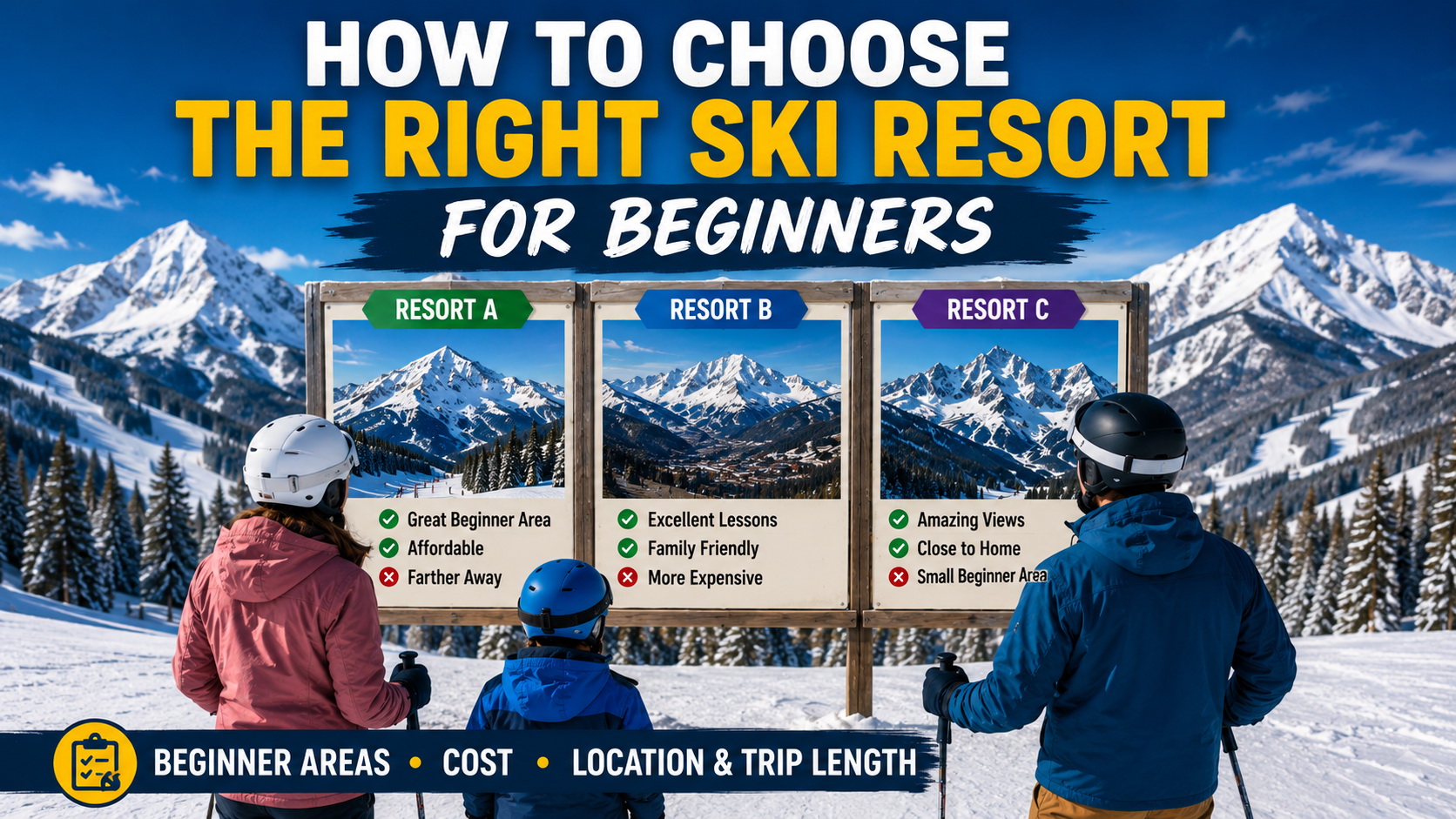
For a beginner, three factors matter most: a dedicated beginner area, the total cost of the trip, and whether the resort is practical as a day trip or destination vacation.
Equipment rentals and ski schools are available at most established resorts. They affect convenience and cost, but they rarely determine whether a mountain is fundamentally suitable for a first-time skier.
Dedicated Beginner Area
The most important factor. Look for a separated learning zone with its own beginner lift and a safe progression route.
Total Trip Cost
Compare the full expense—not only the lift ticket—against the limited portion of the mountain a beginner will actually use.
Trip Location
Decide whether your goal is efficient repeat practice near home or a broader multi-day vacation that includes skiing.
1. A Dedicated Beginner Area Is the Most Important Factor
The first thing to examine is not the size of the resort, the total number of trails, or the percentage of terrain marked as beginner-friendly.
Study the trail map and determine whether the resort has a dedicated beginner learning area.
A practical beginner area should allow a new skier to practice:
- Stopping and turning
- Controlling speed
- Maintaining balance
- Getting up after a fall
- Using a surface lift or beginner chairlift
- Repeating the same movements without entering the main mountain
The best learning areas are relatively separated from faster skier traffic. Experienced skiers often use easy trails as connectors between lifts, so a trail can be officially rated as easy and still feel uncomfortable when faster traffic constantly passes through it.
A dedicated area gives beginners room to hesitate, stop, make wide turns, and repeat basic movements without constantly looking over their shoulders. It also simplifies the first day: collect equipment, meet the instructor, and remain in one controlled area instead of trying to understand the entire mountain.
- Is there a clearly marked learning area?
- Does it have its own lift?
- Is it separated from the main flow of skier traffic?
- Can a beginner remain there without accidentally entering steeper terrain?
- Is there an easy trail available for progression?
- Can a beginner return to the base without skiing a difficult trail?
One well-designed beginner zone may be more useful than several scattered beginner trails at a much larger resort.
Chamonix is a useful real-world example. It is a valley containing separate ski areas, and some are far more practical for beginners than others. The correct decision depends on choosing the right learning zone rather than assuming the entire destination is beginner-friendly.
Read: Is Chamonix Good for Beginners?
2. Compare the Total Cost, Not Just the Lift Ticket
Beginners usually use only a small portion of a ski resort. They do not need hundreds of trails, expert terrain, or access to every lift.
Paying a premium for a famous destination may therefore provide limited value during the first few days of learning. Calculate the complete cost:
- Lift ticket or beginner-area ticket
- Equipment rental
- Ski lesson
- Transportation and parking
- Lodging, when required
- Food
- Flights and baggage fees for destination trips
Some resorts sell lower-priced tickets limited to the beginner area. Others require a full mountain ticket even when a beginner will use only one or two lifts. That difference can be substantial.
Local Resort Versus Major Destination Resort
A smaller local ski area may be the better place to learn because it can offer:
- Lower lift-ticket and lesson prices
- Less expensive rentals
- Free or inexpensive parking
- No hotel expense
- Easier repeat visits for additional practice
A major destination resort may offer better scenery, a larger village, more terrain, and more vacation activities. But a beginner may pay for many features they are not yet able to use.
The practical question is simple: Are you choosing the resort primarily to learn skiing, or planning a broader vacation in which skiing is only one part of the experience?
3. Decide Whether This Is a Day Trip or a Multi-Day Vacation
A resort that works well for a day trip serves a different purpose from a destination that requires flights, lodging, and several days of travel.
Day-Trip Ski Resort
A nearby resort may be the better choice when the priority is learning efficiently:
- No hotel expense
- Lower transportation costs
- Easier return visits
- Less pressure to progress quickly
- More flexibility around weather and fatigue
- The ability to practice over several separate days
Beginner progression depends heavily on repetition. Several shorter visits may be more useful than one expensive trip where the beginner feels pressure to ski every day because the hotel, flights, and lift tickets have already been purchased.
Multi-Day Ski Vacation
A destination resort can make sense when the trip is also intended as a vacation. In that case, personal preferences beyond ski progression become relevant:
- Restaurants, shopping, or nightlife
- Activities for non-skiers
- Sightseeing and mountain-town atmosphere
- Terrain for stronger skiers in a mixed-ability group
- The ability to separate during the ski day and reconnect later
These features do not necessarily help a beginner progress faster. They determine whether the overall vacation works for the people traveling. A resort can therefore be a good vacation choice without being the easiest place to learn.
Beginner Ski Resort Comparison Matrix
| Factor | What to Check | Importance |
|---|---|---|
| Dedicated beginner area | Separate learning zone, beginner lift, limited fast traffic | Most important factor |
| Progression terrain | Easy trail available after the learning zone | Important after basic skills improve |
| Beginner access | Direct from the base or reached by gondola | Convenience factor |
| Lift-ticket cost | Beginner ticket versus full mountain ticket | Major cost factor |
| Lesson cost | Private and group lesson prices | Major cost factor |
| Rental availability | Online booking and on-site rental | Usually available and rarely decisive |
| Distance from home | Driving time and parking requirements | Determines whether repeat day trips are realistic |
| Lodging cost | Hotel price, minimum stays, and resort fees | Major factor for destination trips |
| Mixed-ability group | Beginner lessons plus advanced terrain nearby | Important for families and groups |
| Vacation activities | Restaurants, sightseeing, shopping, and non-ski options | Relevant to the vacation, not directly to progression |
Ski Lessons: Private Lessons Are Usually More Efficient
Most major ski resorts offer instruction, but lesson quality is difficult to judge from a website. A beginner often cannot know whether a specific instructor is an experienced athlete, a highly qualified coach, or someone with more limited teaching experience.
For that reason, the mere existence of a ski school is not an obvious resort differentiator. The more practical choice is between a group lesson and private instruction.
Group Lessons
Group lessons are less expensive, but they are often inefficient because participants may have different fitness levels, confidence, previous experience, learning speeds, and comfort using lifts.
The instructor must teach at a pace that keeps the group together. Faster learners may wait, while skiers who need more attention may feel rushed.
Private Lessons
Private instruction costs more, but usually provides more focused value:
- The pace can be adjusted to one skier
- Specific mistakes can be corrected immediately
- Terrain can be selected based on actual ability
- More time is spent practicing and less time waiting
- The instructor can decide when progression is appropriate
For a short trip, one focused private lesson may provide more value than several group lessons.
The Risk of Arriving Without a Plan
Some beginners choose any famous resort they like, arrive without studying the terrain, and assume they will figure everything out on the mountain. That may work for restaurants or sightseeing. It is much riskier when skiing.
The biggest downside is not simply wasting time or buying the wrong lift ticket. It is the possibility of a serious and costly injury.
A fall on terrain that is too steep for your ability may:
- End the trip immediately
- Require ski-patrol evacuation
- Result in emergency-room or hospital bills
- Create additional transportation and insurance costs
- Prevent you from returning to the workplace
- Require weeks or months of recovery
- Affect responsibilities waiting for you at home
A beginner may enter unsuitable terrain by following stronger friends, selecting the wrong lift, misunderstanding the trail map, or assuming that an officially easy trail will feel easy under current conditions.
Steep slopes are not forgiving of poor preparation. They are also not the place to begin thinking about how to fall safely after you have already lost control. Speed can build quickly, stopping becomes more difficult, and one mistake can have much greater consequences.
Study the trail map, identify the learning area, confirm which lift reaches it, understand how to return to the base, and progress only after you can stop, turn, and control speed consistently.
Is it really worth taking these risks and trying to figure everything out after arrival, rather than spending a few hours pragmatically planning your adventure and giving yourself a much better chance of staying safe?
A Practical Three-Day Beginner Plan
Day One: Learn the Basics
Take a lesson and remain in the dedicated beginner area.
- Balance
- Stopping
- Basic turns
- Speed control
- Using the beginner lift
Day Two: Repeat
Return to the same or similar terrain until stopping and turning become consistent.
Repetition builds control. Do not move on only because the learning slope feels repetitive.
Day Three: Progress Carefully
Try an easy full-length trail only when your instructor believes you are ready.
Confirm that the route returns safely and does not merge into unsuitable terrain.
The objective is not to cover as much terrain as possible. It is to complete a longer trail while remaining in control.
Final Recommendation
Start with three questions:
- Does the resort have a dedicated beginner area?
- Is the total cost reasonable for the terrain you will actually use?
- Is it practical as a day trip, or does the destination justify a multi-day vacation?
Equipment can usually be rented. Lessons can usually be booked. Restaurants, lodging, and resort amenities may improve the vacation, but they do not automatically improve beginner progression.
Choose a nearby, affordable resort when the main objective is efficient learning and repeated practice. Choose a larger destination resort when the trip is also a broader vacation and its location, village, scenery, and activities match the needs of the people traveling.
The right choice depends on whether you are primarily learning to ski—or planning a vacation that happens to include skiing.
Considering Chamonix for Your First Ski Trip?
Apply the same three-factor framework to Chamonix: choose the correct learning area, understand the higher destination cost, and decide whether the broader Chamonix experience justifies the trip.

About the Author
Andy Newman is the founder of Next Outdoor Adventures and has more than 10 years of firsthand skiing experience at major resorts across North America and Europe, including Jackson Hole, Sun Valley, Vail, Chamonix, and Dolomiti Superski.
Andy began skiing in his 40s and progressed from a complete beginner to skiing advanced and double-black-diamond terrain by his late 40s. That progression gives him a practical understanding of the challenges adult beginners face when choosing a resort, taking lessons, selecting appropriate terrain, and building confidence safely.
His ski guides are based on actual resort visits and personal skiing experience—not generic destination descriptions or theoretical trail-map analysis.
Frequently Asked Questions
What is the most important feature of a beginner ski resort?
A dedicated learning area is the most important feature because it gives beginners space to practice stopping, turning, and speed control away from faster mountain traffic.
Is a local ski resort better for beginners?
A local resort can be the more practical choice when progression is the main goal because it reduces lodging and transportation costs and makes repeat practice days easier.
Are private ski lessons better than group lessons?
Private lessons are usually more efficient because the instructor can adjust the pace, terrain, and feedback to one skier instead of managing participants with different abilities.
How many days should a beginner plan for a first ski trip?
Three days provide a practical starting structure: basic movements on Day One, repetition on Day Two, and careful progression to an easy full-length trail on Day Three when ready.
Useful Links for Beginner Ski Trip Planning
- Skiing Blog Hub
- Ski Trip Planning Tips
- Is Chamonix Good for Beginners?
- Ski Trail Rankings Explained: US vs Europe
- Next Outdoor Adventures on YouTube
By Andy Newman, Next Outdoor Adventures founder, July 22, 2026