In This Guide
- Vail terrain summary
- Breckenridge terrain summary
- Quick comparison table
- Transportation from Denver International Airport
- Lodging, dining and town atmosphere
- Terrain by ability level
- Vertical drop, elevation and snow conditions
- Epic Pass considerations
- Should you ski both?
- Final verdict
- Frequently asked questions
Vail vs Breckenridge: Which Colorado Ski Resort Is Better for Your Trip?
Vail and Breckenridge are two of the most famous ski resorts in Colorado, and both are part of the Epic Pass network. For many skiers planning a Colorado ski trip, the decision often starts with the same question: should you ski Vail or Breckenridge?
The short answer is that Vail is usually more appealing for intermediate and advanced skiers who want long groomers, a polished resort village, and the famous Back Bowls. Breckenridge is often a better fit for groups with different ability levels because it combines beginner zones, long blue cruisers, expert terrain, terrain parks, and a historic mountain town.
But this is not only a terrain question. The better resort for your trip also depends on transportation, lodging costs, dining style, altitude, snow conditions, and whether you want to ski one mountain or build a multi-resort Epic Pass trip.
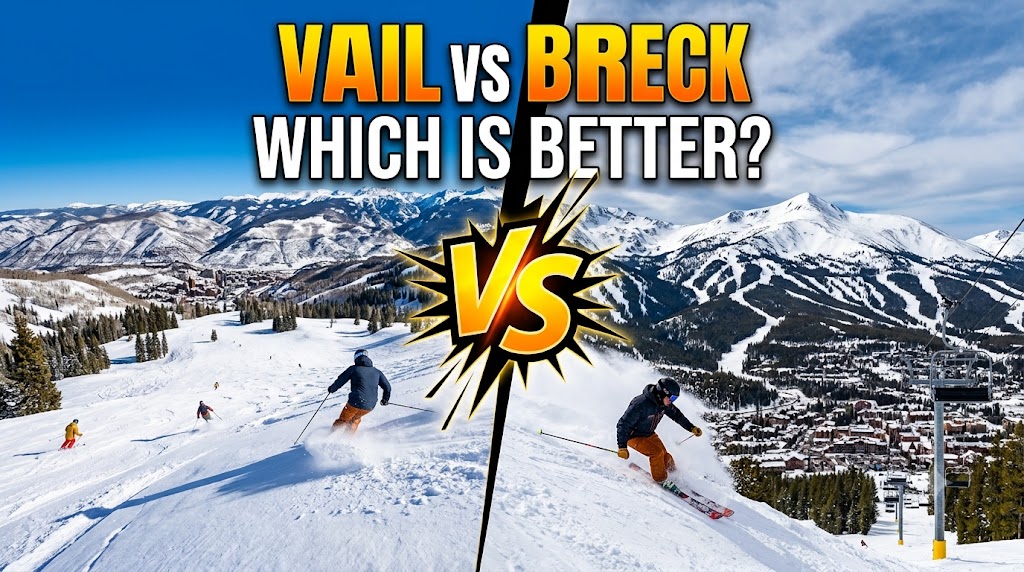
Watch the Vail vs Breckenridge Video
Watch our firsthand Vail vs Breckenridge ski resort comparison for real skiing footage and a visual breakdown of terrain, Back Bowls, high-alpine skiing, lodging, cost, and which resort may be the better fit for your trip.
Background: Vail Terrain Summary
Vail is one of the largest ski resorts in North America and the largest ski resort in Colorado. It has about 5,317 skiable acres, 278 trails, 32 lifts, and an average annual snowfall of about 354 inches. The terrain split is roughly 18% beginner, 29% intermediate, and 53% advanced.
That terrain profile says a lot about the Vail experience. Beginners can ski Vail, but the resort becomes much more rewarding once you are comfortable on blue terrain and ready to explore a large mountain. Vail's front side offers long groomers, learning areas, and classic cruising terrain. The Back Bowls and Blue Sky Basin are the signature experience: wide-open Colorado skiing across huge alpine zones.
Vail is best for skiers who want scale. If your Colorado ski day includes long runs, big views, multiple mountain zones, and bowl skiing, Vail is a strong choice. For a deeper resort-specific planning guide, read Vail Ski Resort for First Timers.
Background: Breckenridge Terrain Summary
Breckenridge is smaller than Vail by acreage but still a major destination resort. Breck has about 2,908 skiable acres, 187 trails, 35 lifts, and average annual snowfall around 355 inches. The terrain split is roughly 11% beginner, 31% intermediate, 24% advanced, and 34% expert.
Breckenridge spreads across five peaks: Peak 6, Peak 7, Peak 8, Peak 9, and Peak 10. That layout is one of Breck's biggest advantages. Peak 9 is useful for beginners and lower intermediates. Peak 7 has long blue cruisers. Peak 8 is the central hub. Peak 6 adds high-alpine intermediate and advanced terrain. Peak 10 is stronger advanced terrain, while Imperial Bowl and Horseshoe Bowl give expert skiers the classic Breckenridge expert terrain experience.
Breck is best for mixed groups. A family or group of friends can include beginners, intermediates, advanced skiers, and non-skiers without everyone feeling like they chose the wrong destination. For a broader framework, read How to Choose the Right Ski Resort for Your Skill Level.
Quick Comparison: Vail vs Breckenridge
| Category | Vail | Breckenridge | Better Choice | Planning Note |
|---|---|---|---|---|
| Pass access | Epic Pass | Epic Pass | Tie | Check your specific Epic product for blackout dates and access rules. |
| Skiable terrain | About 5,317 acres | About 2,908 acres | Vail | Vail feels much larger and more expansive. |
| Trails | About 278 trails | About 187 trails | Vail | Trail count matters less than layout, but Vail offers more total terrain. |
| Vertical drop | About 3,450 feet | About 3,398 feet | Tie | The vertical difference is not the deciding factor. |
| Highest elevation | About 11,570 feet | About 12,998 feet | Breckenridge | Breck feels higher and more alpine, but altitude can affect visitors. |
| Beginner terrain | 18% | 11% | Breckenridge in practice | Peak 9 gives Breck a very useful beginner and progression zone. |
| Intermediate terrain | 29% | 31% | Tie | Vail wins for big cruising; Breck wins for structured progression. |
| Advanced / expert terrain | 53% advanced | 24% advanced, 34% expert | Depends on style | Vail is better for wide-open bowls; Breck is better for high-alpine challenge. |
| Best overall fit | Intermediate and advanced skiers who want bowls and scale | Groups with different ability levels and skiers who want town energy | Depends on your trip | Many Epic Pass skiers should consider skiing both. |
Transportation from Denver International Airport
Most visitors reach both resorts through Denver International Airport. In good conditions, both trips usually take about two to three hours, but winter travel on I-70 can change quickly because of snow, weekend traffic, accidents, chain restrictions, and congestion near the Eisenhower Tunnel.
Interactive Map: Denver International Airport, Breckenridge and Vail
Use this map for orientation before booking lodging or transportation. It shows Denver International Airport, Breckenridge Ski Resort and Vail Ski Resort as a practical Colorado ski-trip route. Exact drive times depend on weather, traffic, road closures and I-70 winter conditions.
Getting to Vail
Vail is roughly 120 to 125 miles from Denver International Airport by road, depending on the exact lodging location. Shuttle operators commonly estimate the trip at about 3 to 3.5 hours in winter conditions, while driving in lighter traffic can be closer to two to two-and-a-half hours.
The main transportation options are a rental car, shared airport shuttle, private shuttle, or flying into Eagle County Regional Airport when flights and pricing make sense. Eagle County Regional Airport is much closer to Vail than Denver, so it can be a major advantage if you want to reduce mountain driving.
Once you arrive in Vail, you may not need a car if you stay in Vail Village, Lionshead, Golden Peak, or a lodging property with shuttle access. Parking can be expensive, and the village areas are designed around walking, lift access, restaurants, and après-ski.
Getting to Breckenridge
Breckenridge is roughly 104 miles from Denver International Airport. Shuttle operators commonly estimate about 2 to 2.5 hours each way depending on season, traffic, and weather.
The main transportation options are a rental car, shared airport shuttle, private shuttle, or bus service. Breckenridge has a practical advantage once you arrive because the town is walkable, the BreckConnect Gondola links town with Peak 8 and Peak 7, and free local transit can help reduce the need for a car during the trip.
For most visitors flying into Denver, Breckenridge is slightly easier and closer. For travelers who can fly into Eagle County Regional Airport, Vail becomes much easier.
Lodging: Vail vs Breckenridge
Lodging is one of the biggest cost differences between these two resorts. Both can be expensive during ski season, but the style and flexibility are different.
Vail is usually the more polished and more expensive lodging destination. Vail Village and Lionshead offer the classic ski-resort experience: walkable streets, hotels, condos, restaurants, shops, and lift access. The tradeoff is price. Ski-in/ski-out and village lodging in Vail can become very expensive during Christmas, New Year's, Presidents Day weekend, spring break, and strong snow periods.
Breckenridge also gets expensive, especially near Peak 8, Peak 9, and Main Street, but it tends to offer more variety. You can find hotels, condos, vacation rentals, townhomes, and group-friendly lodging across town and surrounding neighborhoods. A condo with a kitchen can also help reduce food costs on a multi-day trip.
| Cost Area | Vail | Breckenridge | Lower-Cost Strategy | Practical Takeaway |
|---|---|---|---|---|
| Overall daily trip cost | Often higher; mid-range travel cost estimates are around the mid-$300s per person per day before lift-ticket assumptions vary. | Often slightly lower; mid-range travel cost estimates are around the low-$300s per person per day before lift-ticket assumptions vary. | Travel midweek, avoid holidays, book early, and use a kitchen. | Vail is typically the more premium-priced trip. |
| Lodging | Village and slopeside lodging can be several hundred dollars per night and much higher on peak dates. | Still expensive, but usually more flexible for condos, townhomes, and group stays. | Stay outside the most central base area if shuttle access works. | Breck usually has more value flexibility. |
| Dining | More upscale resort-village dining; casual meals, après-ski, and sit-down dinners add up quickly. | More casual town variety, breweries, pizza, coffee shops, and sit-down options. | Mix restaurants with groceries and condo meals. | Vail wins for polished dining; Breck wins for variety and budget control. |
Dining and Town Atmosphere
Vail dining feels more like a premium resort village. There are casual places, but the overall environment leans upscale. If your ideal ski trip includes après-ski, a walkable village, polished restaurants, and a premium atmosphere, Vail is a strong fit.
Breckenridge has more of a traditional mountain-town feel. Main Street gives visitors restaurants, bars, breweries, coffee shops, casual meals, shops, nightlife, and non-ski activities. This makes Breck easier for groups where not everyone skis all day or where people want more to do after the lifts close.
For a pure resort-village experience, Vail is better. For casual variety and town energy, Breckenridge is better.
Terrain by Ability Level
Beginner Skiers
Vail has beginner terrain, but it is not the main reason to ski Vail. The resort is large, and first-time visitors can feel overwhelmed if they try to move around too much too soon. Beginners should stay in appropriate learning zones and avoid treating the whole mountain as a first-day objective. For a beginner-specific planning checklist, read How to Choose a Ski Resort for Beginners.
Breckenridge is usually the better choice for beginner-focused groups. Peak 9 is one of the most useful beginner and lower-intermediate areas in Colorado. It gives new skiers a clearer progression path without forcing them into a massive mountain layout too early.
Winner for beginners: Breckenridge.
Intermediate Skiers
Both resorts are excellent for intermediate skiers, but they deliver different experiences. Vail gives intermediates long groomers, scenic cruising, and a feeling of moving through a huge ski area. Strong intermediates can explore a lot of terrain without necessarily needing to ski expert lines.
Breckenridge gives intermediates a more structured mountain. Peak 7 has long blue groomers, Peak 9 supports progression, Peak 8 offers a central mix of terrain, and Peak 6 gives stronger intermediates a high-alpine experience when conditions are good.
Winner for intermediates: tie. Vail is better for big cruising and scale. Breckenridge is better for groups and progression.
Advanced Skiers
Vail becomes especially attractive for advanced skiers because of the Back Bowls and Blue Sky Basin. The appeal is not only steepness. It is the amount of open terrain, the scale of the bowls, and the ability to spend much of the day moving through different zones.
Breckenridge also has excellent advanced terrain, especially on Peak 6, Peak 8, Peak 10, Horseshoe Bowl, and Imperial Bowl. Breck's advanced skiing feels more high-alpine and exposed, while Vail's advanced skiing feels broader and more expansive.
Winner for advanced skiers: Vail for bowl skiing; Breckenridge for high-alpine terrain.
Expert Skiers
Expert skiers should not overlook Breckenridge. Imperial Bowl, Horseshoe Bowl, high-alpine terrain, hike-to options, and wind-loaded upper-mountain conditions can create a serious expert experience. The elevation and exposure are part of the character.
Vail also has expert terrain, trees, steeper pitches, and challenging bowl zones, but many skiers think of Vail more as a massive advanced playground than a technical expert-only mountain.
Winner for experts: Breckenridge for high-alpine challenge; Vail for scale and variety.
Vertical Drop, Elevation and Snow Conditions
The vertical drop is very similar: Vail is about 3,450 feet, and Breckenridge is about 3,398 feet. In real trip planning, this difference should not drive your decision. Terrain layout matters more than the raw vertical number.
Vail starts lower, with a base elevation around 8,120 feet and a high point around 11,570 feet. That can make it more comfortable for visitors who are sensitive to altitude. The tradeoff is that lower-elevation terrain can be more affected by warm periods, especially early or late in the season.
Breckenridge sits higher, with a base elevation around 9,600 feet and a high point around 12,998 feet. Higher elevation can help preserve snow quality, especially in colder patterns and late season, but it can also make altitude more noticeable for visitors coming from sea level.
Both resorts average around 350 inches of snowfall on official resort stats, but daily conditions still vary. Wind, visibility, aspect, elevation, freeze-thaw cycles, and storm track matter. Vail can be excellent when the Back Bowls have soft snow. Breckenridge can be excellent when the high alpine is open and visibility is good. Either resort can feel very different from one day to the next.
Epic Pass Considerations
Both Vail and Breckenridge are on the Epic Pass. That makes this comparison more strategic because you may not need to choose only one resort. Depending on your pass product and blackout dates, you can build a trip that includes both Vail and Breckenridge, and potentially Beaver Creek or Keystone as well.
Before booking, check your exact Epic Pass product. For a pass-level planning comparison, read Ikon vs Epic Pass 2026. Full Epic Pass access is different from Epic Local Pass, Epic Day Pass, Summit Value Pass, or other restricted products. Peak-date restrictions can matter during Thanksgiving, Christmas and New Year's, Martin Luther King Jr. weekend, and Presidents Day weekend.
Should You Ski Both Vail and Breckenridge?
Yes, if you have several ski days, skiing both Vail and Breckenridge can be the best option. The drive between the two resorts is roughly 45 minutes to one hour in good conditions, depending on where you stay, traffic, and weather.
That proximity matters. If you are flying to Colorado, paying for lodging, using an Epic Pass product, renting gear, and investing several days into the trip, visiting more than one iconic resort can give you a more value from the trip.
A simple multi-day plan could look like this:
- Day 1: arrive, pick up rentals if needed, adjust to altitude.
- Day 2: ski Breckenridge and use the town for dinner.
- Day 3: ski Breckenridge again, or use Keystone as a lower-stress Epic option.
- Day 4: ski Vail and focus on front-side groomers plus the Back Bowls if conditions are good.
- Day 5: ski Vail again, or add Beaver Creek for a polished groomer day.
- Day 6: depart or add a recovery day before flying home.
This type of plan gives you variety, reduces the pressure to make one resort perfect, and creates a more memorable Colorado ski trip.
Final Verdict: Is Vail or Breckenridge Better?
The ultimate answer depends on your ski level and aspirations.
Choose Vail if you are an intermediate or advanced skier who wants a large mountain, long groomers, famous Back Bowls, Blue Sky Basin, a polished village, and the large Colorado destination-resort experience. Vail is especially appealing if bowl skiing is one of your main reasons for coming to Colorado.
Choose Breckenridge if you are traveling with a group of different ability levels, want a real mountain town, need more lodging flexibility, or want a resort where beginners, intermediates, advanced skiers, and experts can all find appropriate terrain. Breck is also a strong choice if Imperial Bowl and high-alpine skiing are part of your Colorado trip plan.
But because Vail and Breckenridge are close enough to combine during a multi-day trip, the best answer may be to ski both. Vail is famous for its bowls. Breckenridge is famous for its Five Peaks and Imperial Bowl. Both are iconic Colorado ski destinations, and visiting both can create a more complete Colorado ski trip from the same Epic Pass trip.

About the Author
Andy Newman is the founder of Next Outdoor Adventures and has more than 10 years of firsthand skiing experience at major resorts across North America and Europe, including Jackson Hole, Sun Valley, Vail, Chamonix, and Dolomiti Superski.
Andy began skiing in his 40s and progressed from a complete beginner to skiing advanced and double-black-diamond terrain by his late 40s. That progression gives him a practical understanding of the challenges skiers face when comparing resorts, choosing appropriate terrain, and planning trips for different ability levels.
His ski guides are based on actual resort visits and personal skiing experience—not generic destination descriptions or theoretical trail-map analysis.
FAQ: Vail vs Breckenridge
Is Vail or Breckenridge better for beginners?
Breckenridge is usually the better choice for beginner-focused groups because Peak 9 provides a clearer beginner and lower-intermediate progression area. Vail has beginner terrain, but the resort is larger and can feel more complicated for first-time visitors.
Is Vail or Breckenridge better for intermediate skiers?
Both resorts are strong for intermediate skiers. Vail is better for long groomers, scale and scenic cruising, while Breckenridge is better for structured progression across Peak 7, Peak 8, Peak 9 and Peak 6.
Is Vail or Breckenridge better for advanced skiers?
Vail is usually better for advanced skiers who want wide-open bowl skiing and a very large mountain. Breckenridge is better for skiers who want higher alpine terrain, more exposed upper-mountain terrain and expert progression.
Which resort is easier to reach from Denver International Airport?
Breckenridge is usually slightly easier to reach from Denver International Airport because it is closer by road. Vail can be easier when travelers use Eagle County Regional Airport, which is much closer to Vail than Denver.
Should Epic Pass skiers ski both Vail and Breckenridge?
Epic Pass skiers with several ski days should consider skiing both. Vail and Breckenridge are close enough to combine during a multi-day Colorado trip, and they offer different terrain styles.
Watch the Vail and Breckenridge First Timers Guides
Watch the detailed first-timers guides on YouTube. Each guide includes terrain footage and real-time skiing impressions from each resort.