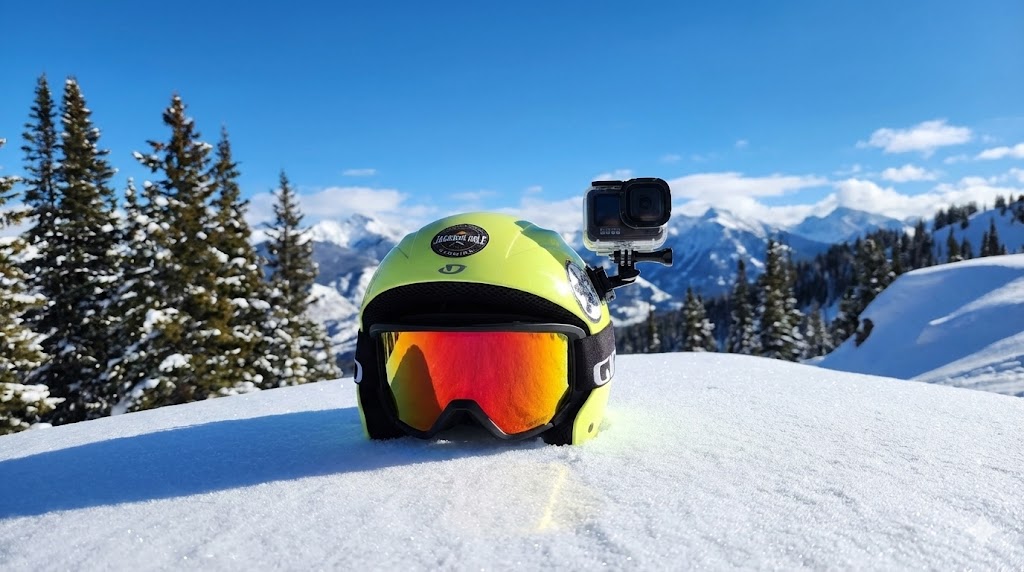
Quick answer: A GoPro is worth it for skiing if you want stable hands-free POV footage, film multiple ski days, create YouTube or travel videos, or care about capturing real resort terrain. It is probably not worth buying only for one casual ski trip or a few short clips. For skiing, the setup matters as much as the camera: helmet mount, spare batteries, realistic field of view, and settings that handle snow glare.
Skiing is one of the most demanding environments for action cameras. Holding a phone while skiing is impractical, especially on advanced terrain with steep slopes, cliffs, crowds, and variable snow. Cold temperatures drain batteries, snow glare challenges exposure, and constant vibration tests stabilization. Based on real resort filming and ski POV footage, this guide explains when a GoPro is worth it for skiing — and when it may be more camera than you need.
In This Article
This article focuses on real use cases, practical setup decisions, and common mistakes skiers make when filming their runs.
In this guide, we cover:
- What skiing demands from an action camera in real on‑mountain conditions
- The camera setup used to film real ski POV footage, including mounts and batteries
- Whether a GoPro is actually worth buying for skiing—pros, cons, and limitations
- Recommended GoPro settings for snow, glare, and variable terrain
- Common mistakes skiers make when filming with an action camera
- Who should and should not consider buying a GoPro for skiing
This article is based on real skiing experience and filmed footage rather than manufacturer specifications or marketing claims. At the time of writing, GoPro offers newer models such as the HERO13 Black with additional capabilities. However, this guide reflects first‑hand experience using the GoPro Hero13 Black in a wide range of real‑world conditions. It is not a theoretical review.
What Skiing Demands From an Action Camera
Before deciding whether a GoPro is worth buying, it is important to understand what skiing requires from a camera.
Cold Weather Performance
Cold temperatures significantly reduce battery life. Cameras that perform well in warm environments often struggle on chairlifts and long runs in sub‑freezing conditions.
Stabilization on Uneven Terrain
Skiing involves rapid direction changes, vibration, and constantly changing snow conditions. Stabilization quality directly determines whether footage is smooth and watchable or shaky and unpleasant.
High‑Contrast Lighting
Snow reflects light aggressively. Cameras must handle bright highlights without losing detail or underexposing skiers, trees, or terrain features.
Hands‑Free Operation
Skiers need mounts that allow hands‑free filming. Chest and helmet mounts must remain stable and unobtrusive while skiing crowded trails and riding lifts. Changing recording settings directly on the camera can be impractical in freezing temperatures, especially in wind or extreme cold. Access to a mobile app that allows quick switching between profiles—such as panoramic or high‑contrast settings—is extremely valuable.
The Camera Setup Used for Our Ski POV Footage
For filming ski resorts and real‑time skiing experiences, the setup is just as important as the camera itself.
Camera
Most videos published on our channel were filmed using the GoPro Hero13 Black. It proved reliable for capturing 4K footage across a wide range of conditions, including extreme cold with temperatures reaching approximately –33°F.
The GoPro Hero13 Black is capable of:
- High frame rates (60 fps or higher)
- 5K resolution with multiple digital lens options (Wide, Linear, Linear + Horizon Leveling, Narrow)
- Strong in‑camera stabilization
- Reliable performance in cold environments
The setup that worked best for most videos—including those filmed in extreme cold—was:
- Video Resolution: 4K (3840 × 2160)
- Frame Rate: 30 fps
- Lens: Linear + Horizon Leveling
- White Balance: Auto
- Sharpness: High
- Color: GoPro Color
- Hindsight: Off
- HyperSmooth: Boost
- MicroSD Card Capacity: 1 TB
While the camera supports higher resolutions and frame rates, increasing either often leads to faster battery drain and larger storage requirements. Combined with cold temperatures, this can result in frequent battery changes or the need for additional memory cards—interruptions that take time away from skiing and enjoying the terrain.
Mount
Before using a helmet mount, we tested a chest mount and found it inconvenient due to straps over ski jackets and excessive camera movement tied to body motion. Early chest‑mounted footage often felt unstable and less immersive. After switching to a helmet mount, we never returned to the chest mount for skiing, although chest mounts remain an excellent option for hiking or climbing.
Key takeaways:
- Helmet mounts provide natural‑looking POV footage and better terrain visibility
- Chest mounts can feel restrictive, capture excessive body movement, and include skis or clothing in the frame—less ideal for panoramic terrain shots
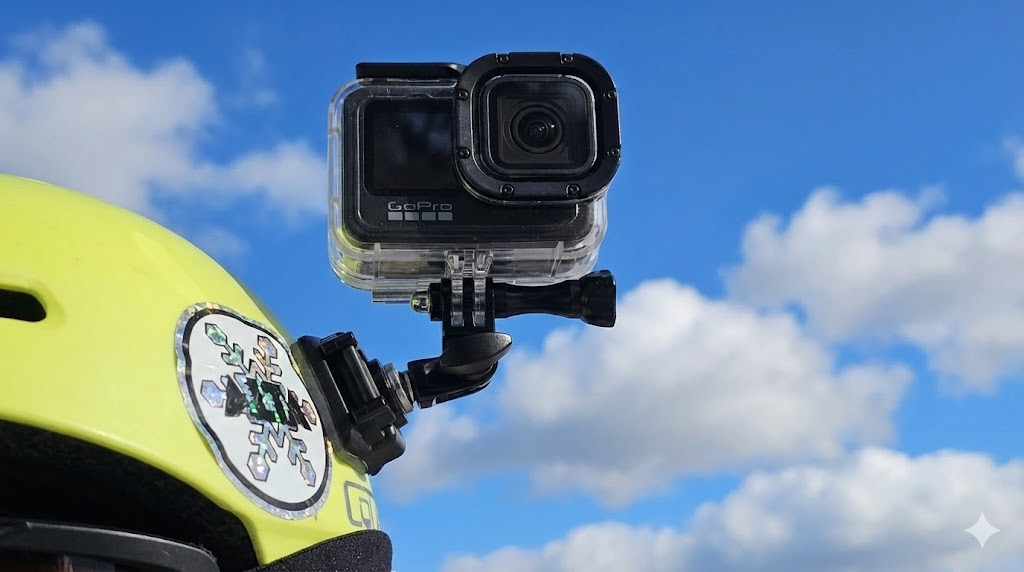
Helmet-mounted GoPro Hero13 Black.
Battery
We initially experimented with cold‑optimized batteries but ultimately found that carrying multiple standard batteries was more reliable. A pack of 8–10 spare batteries stored in pockets or a backpack ensures uninterrupted filming. Relying on a single premium battery is risky in extreme cold, where even optimized batteries can drain quickly.
Key takeaways:
- Carry at least 4–5 batteries for cold‑weather skiing
- For full‑day filming across large resorts, carry 8–10 batteries
- A multi‑battery charging station is highly recommended for overnight charging
Accessories
- Electronic lens wipes are essential—snowflakes or moisture on the lens can ruin footage
- Protective housing helps safeguard the camera from impacts or falls
- Newer models offer additional accessories worth considering depending on filming needs
Why This Setup Works
This configuration balances stability, field of view, and comfort during long ski days without constant adjustments.
- 4K at 30 fps provides a strong balance between quality, storage, and editing requirements
- Helmet mounting combined with mobile app control allows quick setting changes without distractions
- Sufficient batteries and storage allow continuous filming throughout the day
Is a GoPro Actually Worth It for Skiing?
Where GoPro Excels
Stabilization
Modern GoPro models deliver excellent stabilization, handling uneven snow, chopped‑up trails, and vibration far better than older action cameras.
Video Quality
Footage remains sharp in flat light and mixed sun‑and‑shadow conditions. In clear weather, Wide and Horizon‑Leveled lenses enable cinematic results that look great on large screens.
Ease of Use
Quick‑start recording, glove‑friendly buttons, voice control, and mobile app access are especially valuable in freezing temperatures.
| Where GoPro Excels | Limitations to Consider |
|---|---|
|
|
Where GoPro Falls Short
Battery Life in Cold
Cold weather reduces runtime significantly. Carrying spare batteries is essential for extended filming.
Wide‑Angle Distortion
Default wide settings can make slopes appear flatter than they feel. Pre‑configuring profiles helps avoid this issue.
Overkill for Casual Skiers
If you ski only once per year and want a few short clips, a GoPro may be more than necessary. However, its versatility across travel and outdoor activities may still justify the purchase.
Recommended GoPro Settings for Skiing
Correct settings matter more than the camera model itself.
Video Resolution and Frame Rate
- 4K at 60 fps for very smooth motion
- 4K at 30 fps or 2.7K at 60 fps for better battery life and reduced storage use
Field of View
- Use Linear or Narrow for realistic slope steepness
- Avoid ultra‑wide lenses for action runs
Stabilization
- Enable full stabilization
- External gimbals are unnecessary for skiing
Exposure Tips
- Slightly reduce exposure compensation
- Lock exposure in consistent lighting to avoid flicker
Common Mistakes Skiers Make
- Using chest mounts that exaggerate body movement
- Recording continuously and draining batteries unnecessarily
- Leaving batteries exposed on chairlifts
- Overusing ultra‑wide angles that flatten terrain
Who Should Buy a GoPro for Skiing
GoPro Is Worth It If You:
- Ski frequently or film other outdoor activities
- Enjoy POV filming
- Create travel or resort videos
- Want stable footage without complex setups
GoPro Is Probably Not Worth It If You:
- Ski only once per season
- Want only occasional clips
- Prefer casual phone footage
Final Verdict
For skiers who value stable POV footage, realistic terrain capture, and dependable cold‑weather performance, a GoPro is worth the investment when used correctly. It is not the cheapest option and not necessary for everyone, but for frequent skiers and content creators, it remains one of the most practical tools for filming on the mountain.
FAQ: GoPro for Skiing
Is a GoPro worth it for skiing?
A GoPro is worth it if you ski frequently, film POV footage, create resort videos, or want hands-free clips that are more stable than phone footage. It is probably not necessary if you ski once per season and only want a few casual clips.
Is a helmet mount or chest mount better for skiing?
For most ski POV footage, a helmet mount works better because it gives a more natural view of the terrain and avoids excessive body movement. Chest mounts can work, but they can feel restrictive over ski jackets and may capture too much body motion.
What GoPro settings work well for skiing?
A practical skiing setup is 4K at 30 fps or 60 fps, Linear or Linear + Horizon Leveling, HyperSmooth enabled, GoPro Color, Auto White Balance, and careful exposure management in bright snow.
How many GoPro batteries do you need for skiing?
For cold-weather skiing, carry at least four to five batteries. For full-day filming across large resorts, carrying eight to ten batteries is more reliable.
What is the biggest GoPro mistake skiers make?
The biggest mistakes are filming continuously, draining batteries in the cold, using ultra-wide settings that flatten terrain, and not checking the lens for snow or moisture.
Related Ski Filming and Planning Guides
- Watch ski trail videos filmed by Next Outdoor Adventures
- Ski trip planning tips
- Ski trail rankings explained
- How to know if you are ready for steep slopes
Disclosure
Some links on this page may be affiliate links. This does not influence editorial opinions or recommendations.
Want to see real POV footage?
Visit our YouTube channel for full ski trail videos and resort overviews.
Watch Real POV Ski Footage
About the Author
Andy Newman is the founder of Next Outdoor Adventures and has more than 10 years of firsthand skiing experience at major resorts across North America and Europe, including Jackson Hole, Sun Valley, Vail, Chamonix, and Dolomiti Superski.
Andy began skiing in his 40s and progressed from a complete beginner to skiing advanced and double-black-diamond terrain by his late 40s. That progression gives him a practical understanding of ski equipment, on-mountain filming, cold-weather conditions, terrain selection, and the challenges of capturing real POV ski footage.
His ski guides are based on actual resort visits and personal skiing experience—not generic destination descriptions or theoretical gear summaries.